

CSS Electronics CAN bus data logger

Specification comparison of the CSS Electronics CAN loggers
CANedge1 and CANedge2 are 100% identical except for the WiFi functionality in CANedge2. Likewise, CANedge1 and CANedge3 are identical except for the 4G LTE functionality of CANedge3. Also note that CANedge1/CANedge2 supports optional GNSS/IMU, while this is part of CANedge3 by default.
If you only need to collect your CAN data infrequently and the device is physically easily accessible, then CANedge1 is usually sufficient. However, if you need to collect your data frequently and preferably remotely, the CANedge2/CANedge3 will quickly become worthwhile. Especially if you need to collect data on a fleet of vehicles or machines, CANedge2/CANedge3 are far more practical and cost-effective.
A CANedge connected via WLAN/LTE offers the additional advantage that you can fully automate your data collection and data processing workflow. For example, you can set up automated Python API scripts to modify your data, decode it via DBC - and set up telematics dashboards, for example. The CANedge2 is also easier to manage in the field, as you can monitor the status via the CANcloud telematics platform and perform over-the-air configuration and firmware updates, for example.
For use cases where a Wi-Fi network is available, we recommend the CANedge2. If you need to upload data via 4G LTE (cellular), we recommend the CANedge3.
The CANedge is the 2nd generation of the CLX000. In general, we recommend using the CANedge for data logging applications, while the CLX000 is particularly recommended if you need to stream data via USB.
Differences CL1000/2000 & CANedge
The most important improvements of the CANedge compared to the CLX000 include
Mechanical
- Extractable SD: The SD can be extracted to transfer data at 80 MB/s (compared to 0.5 MB/s for the CLX000 via USB).
- Industrial SD card: The CANedge utilises an industrial SD card, improving performance, lifetime, temperature range and more
- Channels: 2 x CAN/LIN channels, enables parallel logging of 2 x CAN + 2 x LIN
- Aluminium housing: The new housing is just as compact as the CLX000, but significantly more robust and offers flanges for mounting
- Power output: Supply external modules with power via the 2nd port, e.g. a GPS-to-CAN or temperature-to-CAN module
- Robust protection: The CANedge has a stronger protection specification, for example against voltage peaks
Protocol files and software/API
- MDF4 log files: Popular binary MDF4 format - more compact than CSV, faster to process, supported by many CAN tools
- Configuration: The open source configuration editor can be used online or offline via your browser
- JSON schema: configuration files are based on the standardised JSON schema concept supported by many open source tools
- Converters : Lightweight open source converters allow drag & drop/CLI conversion from MDF4 to e.g. *.csv and *.asc
- asammdf GUI : Enables user-friendly editing of MDF4 log files, DBC conversion (incl. OBD2/J1939), graphical representations and more
- Python API : Easily process your data at scale and automate the creation of e.g. reports/databases/dashboards
- MATLAB : Log files can be natively integrated into the MATLAB Vehicle Network Toolbox
- Dashboards : Easily visualise your data in free customisable Grafana dashboards
Data acquisition
- Lossless: The CANedge can log full bus loads without message loss (the CLX000 is limited to ~800-1000 frames/sec).
- Compression: With the optional compression, you can reduce the file size by up to 80 % compared to the CLX000
- Encryption: With the optional encryption, you can encrypt log files on the SD card for additional security
- Extended configuration: Extended filters and transmission lists (e.g. up to 128 filters compared to 8 with the CLX000)
- Precision: 20 times higher RTC resolution (50 microseconds) - with advanced RTC synchronisation options
- Boot time: Much faster boot time compared to the CLX000 (~1 sec. vs. ~10 sec.)
- CAN FD: The CANedge supports CAN FD (Flexible Data Rate) and is therefore future-proof
- Trigger: Control when logging/transmission should be started/stopped based on user-defined CAN signal thresholds
- Error frame: The CANedge supports the logging of CAN/LIN error frames
- LIN slave/master: The CANedge can serve as both a LIN slave and a LIN master (publisher).
GNSS/IMU + connectivity
- GNSS/IMU: The CANedge supports optional integrated GNSS/IMU functionality
- WLAN: The CANedge2 supports WLAN data transmission to your own cloud/self-hosted server (incl. OTA updates)
- 4G LTE: The CANedge3 supports 4G LTE data transmission to your own cloud/self-hosted server (incl. OTA updates)
| Model comparison | 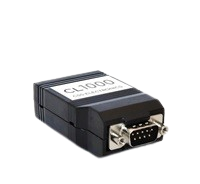 CL1000 | 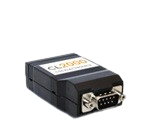 CL2000 | 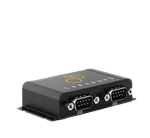 CANedge1 | 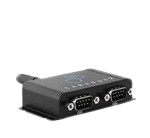 CANedge2 | 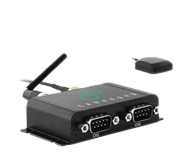 CANedge3 |
|---|---|---|---|---|---|
| Number of CAN channels | 1 | 1 | 2 | 2 | 2 |
| Number of Lin channels | - | - | 2 | 2 | 2 |
| CAN FD | - | - | Yes | Yes | Yes |
| RTC timestamp | - | Yes (1ms) | Yes (0.05 ms) | Yes (0.05 ms) | Yes (0.05 ms) |
| Frames per second | ~800-1000 | ~800-1000 | 3000+ | 3000+ | 3000+ |
| Logging to SD card | Yes | Yes | Yes | Yes | Yes |
| Industrial and extractable SD | - | - | Yes | Yes | Yes |
| Log file format | .txt | .txt | MDF4 (.MF4) | MDF4 (.MF4) | MDF4 (.MF4) |
| Cyclical logging | Yes | Yes | Yes | Yes | Yes |
| Silent mode | Yes | Yes | Yes | Yes | Yes |
| Automatic bit rate detection | Yes | Yes | Yes | Yes | Yes |
| Filter and prescaling | Basic | Basic | Advanced | Advanced | Advanced |
| Transmit lists | Basic | Basic | Advanced | Advanced | Advanced |
| Control signal (trigger) | Basic | Basic | Extended | Advanced | Advanced |
| Data compression and encryption | - | - | Yes | Yes | Yes |
| Logging of CAN/LIN error frames | - | - | Yes | Yes | Yes |
| USB streaming to PC | Yes | Yes | - | - | - |
| GNSS/IMU support | - | - | Optional | Optional | Yes |
| Secure WLAN/LTE data transmission | - | - | - | W-lan | 3G/4G LTE |
| Over-the-air configuration/firmware | - | - | - | Yes | Yes |
| Configuration editor | Yes | Yes | Yes | Yes | Yes |
| Support for DBC conversion | Yes | Yes | Yes | Yes | Yes |
| Convert data to e.g. ASC, TRC | Yes | Yes | Yes | Yes | Yes |
| Graphical plot support | - | - | Yes | Yes | Yes |
| Data processing API | - | - | Yes | Yes | Yes |
| Dashboard integration | - | - | Yes | Yes | Yes |
| Telematics cockpit | - | - | - | Yes | Yes |
| L x W x H (mm) | 67 x 43 x 24 mm | 67 x 43 x 24 mm | 75 x 47 x 20 mm | 75 x 47 x 20 mm | 75 x 47 x 20 mm |
| Weight (g) | 50 | 50 | 100 | 100 | 100 |