


Learn how to select an oscilloscope for power electronics and embedded systems. This article explains key technical features, compares different types of instruments, clarifies specific measurement requirements, and highlights the importance of choosing the right probes. Ideal for electronics engineers, developers, and test engineers. Learn how to avoid common purchasing mistakes and make informed decisions about your instrumentation.
At a glance
- The choice of an oscilloscope depends heavily on the application and measurement requirements.
- Bandwidth, sampling rate, memory depth and vertical resolution are key criteria.
- Benchtop and portable oscilloscopes serve different use cases.
- Isolated channels are particularly important for power electronics and safety.
- Choosing the right oscilloscope probe is crucial for safe and accurate measurement results.

Introduction: Importance of oscilloscope selection in research and development
Choosing the right oscilloscope is crucial in the development and testing of power electronics and embedded systems. This versatile measuring instrument enables the precise analysis of electrical signals and is an indispensable tool for electronics engineers, hardware developers, R&D professionals, and test engineers. Understanding how to select an oscilloscope helps minimize measurement errors, reduce development time, and ultimately lead to high-quality products.
- Crucial for precise measurements
- Minimizes development errors
- Increases measurement accuracy and efficiency
Key technical specifications for selecting an oscilloscope
Choosing the right oscilloscope begins with evaluating key technical features that greatly influence measurement quality and capability:
1. Oscilloscope bandwidth: This determines the highest frequency the device can reliably measure. For power electronics and fast embedded signals, a bandwidth of at least three times the highest signal frequency is recommended.
2. Sampling rate: This defines how often the signal is sampled per second. Higher sampling rates allow for more precise reconstructions of fast signals.
3. Memory depth: Crucial for recording long signal segments at high resolution. Important for detailed analysis and trigger events.
4. Vertical resolution: Affects the accuracy of the voltage measurement. Higher resolution allows for finer signal differentiation.
5. Number of channels: More channels allow for parallel measurements of multiple signals, which is important for complex systems.
6. Trigger functions: Essential for targeted signal acquisition, especially in the case of rare or complex events.
7. Interfaces/Connectivity: USB, LAN or Wi-Fi for integration into test benches or for remote diagnostics.
8. Probe compatibility: Suitable probes are essential for precise measurements and should be readily available.
- At least 3x bandwidth of the highest signal frequency
- Sampling rate for fine signal reproduction
- Sufficient channels for parallel measurements
| feature | Meaning | Typical values |
|---|---|---|
| bandwidth | Maximum frequency measurement | 50 MHz to several GHz |
| Sampling rate | Signal sampling per second | 100 MS/s to several GS/s |
| Storage depth | Signal section length | At least several megapoints |
| Vertical resolution | Voltage resolution | 8 to 16 bits |
| Channels | Number of simultaneous measurements | 2 to 8 channels |
Benchtop vs. Portable Oscilloscopes: When is which device appropriate?
When choosing between benchtop and portable oscilloscopes, you should consider the application location, measurement requirements, and mobility needs:
Benchtop oscilloscopes typically offer higher bandwidth, improved performance, and extensive features. They are ideal for laboratories, development workstations, and test benches with a fixed installation location.
Portable or handheld oscilloscopes are advantageous due to their mobility and ease of use on-site, for example during field measurements or rapid diagnostics in production. They are compact, require less power, and are more resistant to environmental influences.
PC-based oscilloscopes offer high flexibility, can be cost-effective, but require an external computer and usually additional hardware.
Automotive oscilloscopes are specifically designed for vehicle measurements, CAN bus analysis, and rugged environments.
Isolated channel oscilloscopes offer advantages when measurements with different reference potentials are required without ground loops or signal distortions, especially in the field of power electronics.
- Benchtop for laboratories and comprehensive analyses
- Portable for field and rapid measurements
- Isolated channels to avoid interference

| type | Advantages | Disadvantages | Typical areas of application |
|---|---|---|---|
| Benchtop | High bandwidth, extensive features | Hardly mobile, high price | Laboratories, development environments |
| Portable | Mobile, robust, fewer features | Lower bandwidth, limited storage | Fieldwork, production |
| PC-based | Flexible, cost-effective | Dependence on an external PC | Laboratory, education, simple applications |
| Automotive | Robust CAN bus analysis | Specialized, more expensive | Vehicle development, diagnostics |
Special features of oscilloscopes for power electronics testing
Power electronics places special demands on oscilloscopes. Fast switching operations, high voltages, and complex signal waveforms require specialized measuring instruments and probes.
- Wide bandwidth for detecting high-frequency switching operations
- Isolated channels to avoid ground loops and signal distortion
- High vertical resolution for precise voltage measurements
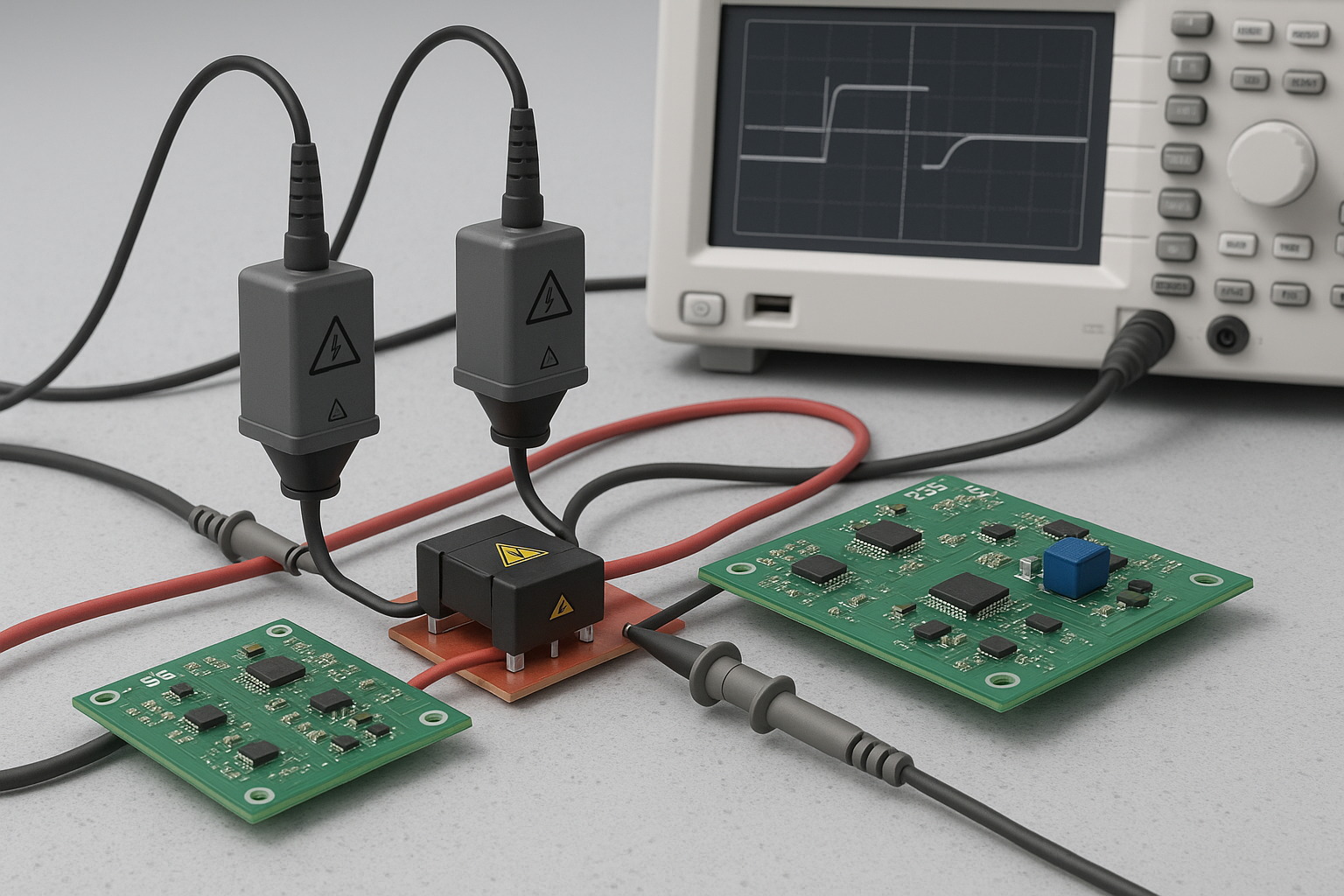
Differential probes and current clamps for safe and accurate measurements of voltages and currents
- Powerful trigger options for detecting transient phenomena such as overvoltages or switching spikes
In practice, oscilloscopes with isolated channels are often recommended to minimize sources of error due to ground reference and to increase safety.
- High bandwidth and isolated channels
- Differential and current probes are used
- Powerful trigger functions
Measurement requirements in embedded systems development
Digital and mixed-signal measurements are often a key focus in the development of embedded systems. Requirements include, among others:
- Multi-channel oscilloscopes for analyzing bus systems and synchronizing signals
- High sampling rates for fast digital signals
- Protocol triggers and decoding functions (e.g. I2C, SPI, UART)
- Compact and PC-based models for flexibility in development environments
- Integration with logic analyzers and debugging tools
The selection of a suitable oscilloscope depends heavily on the type of signal to be analyzed and the environment.
- Multi-channel analysis for buses and signals
- Use integrated protocol analysis
- Integration with debug tools
The importance of the correct oscilloscope probes
Choosing the right probe is just as important as the oscilloscope itself. Different probe types are required to perform measurements safely and accurately:
- Voltage probes: For standard voltage measurements with different bandwidths and damping factors
- Differential probes: For measurements between two floating points without a ground reference, essential in power electronics
- Current probes: Allow non-contact or invasive current measurements; differ in bandwidth and measuring range.
An unsuitable probe can lead to measurement errors, safety risks, or signal distortion. Therefore, probes should be carefully selected with regard to their compatibility with the oscilloscope and the device under test.
- Select the appropriate voltage probes
- Differential probes for floating measurements
- Current probes for reliable current measurements
Practical examples and common mistakes when selecting an oscilloscope
Many oscilloscope purchases result in poor investments when important technical aspects or the intended use case are neglected. Examples:
- Selection of a device with insufficient bandwidth for the signals to be measured
- Neglecting the required memory depth when analyzing long signal sequences
- Underestimating the importance of isolated channels in power electronics
- Lack of compatibility of the probes for common signal measurements
This risk can be minimized through systematic needs analysis and prioritization of essential characteristics. A structured approach facilitates selection and ensures reliable measurements.
- Don't underestimate bandwidth.
- Select sufficient memory depth
- Use insulated channels if required
Decision framework and recommendations for different applications and budgets
To simplify the selection process, we recommend a decision framework based on application, technology, and budget:
1. Define application profile: Power electronics, embedded development, diagnostics, fieldwork?
2. Clarify minimum technical requirements: bandwidth, sampling rate, channels, probe requirements
3. Select device type: Benchtop, Portable, PC-based or Special Device
4. Set a budget and check market supply
5. Select suitable probes and accessories
For high-end power electronics, benchtop oscilloscopes with high bandwidth and isolated channels are ideal. Embedded system developers benefit from multi-channel and protocol analysis tools. Wall-mounted or portable equipment with basic functions is perfect for mobile use.
A careful analysis avoids bad investments and ensures optimal measurement results.
- Analyze needs precisely
- Define minimum technical requirements
- Choose the right device type and budget
Frequently Asked Questions
How do I choose the correct bandwidth for an oscilloscope?
The bandwidth should be at least three times the highest signal frequency being measured to ensure accurate signal reproduction.
What is the ideal sampling rate for embedded systems?
For embedded systems, a sampling rate of at least five times the highest signal frequency is recommended in order to be able to cleanly capture digital signals.
When is an isolated channel oscilloscope necessary?
Isolated channels are necessary when measurements with different reference potentials are to be carried out without ground loops or signal distortions, especially in power electronics.
How important is storage depth in measurements?
Sufficient memory depth is crucial to store long signal segments at high resolution without losing detail.
What advantages do portable oscilloscopes offer compared to benchtop models?
Portable oscilloscopes are mobile, lightweight and robust, ideal for field measurements and quick diagnoses outside the laboratory.
How do oscilloscope probes differ and how do I choose the right one?
Voltage probes measure standard voltages; differential probes are suitable for floating measurements without a ground reference, and current probes measure electric currents non-contact or invasively.