





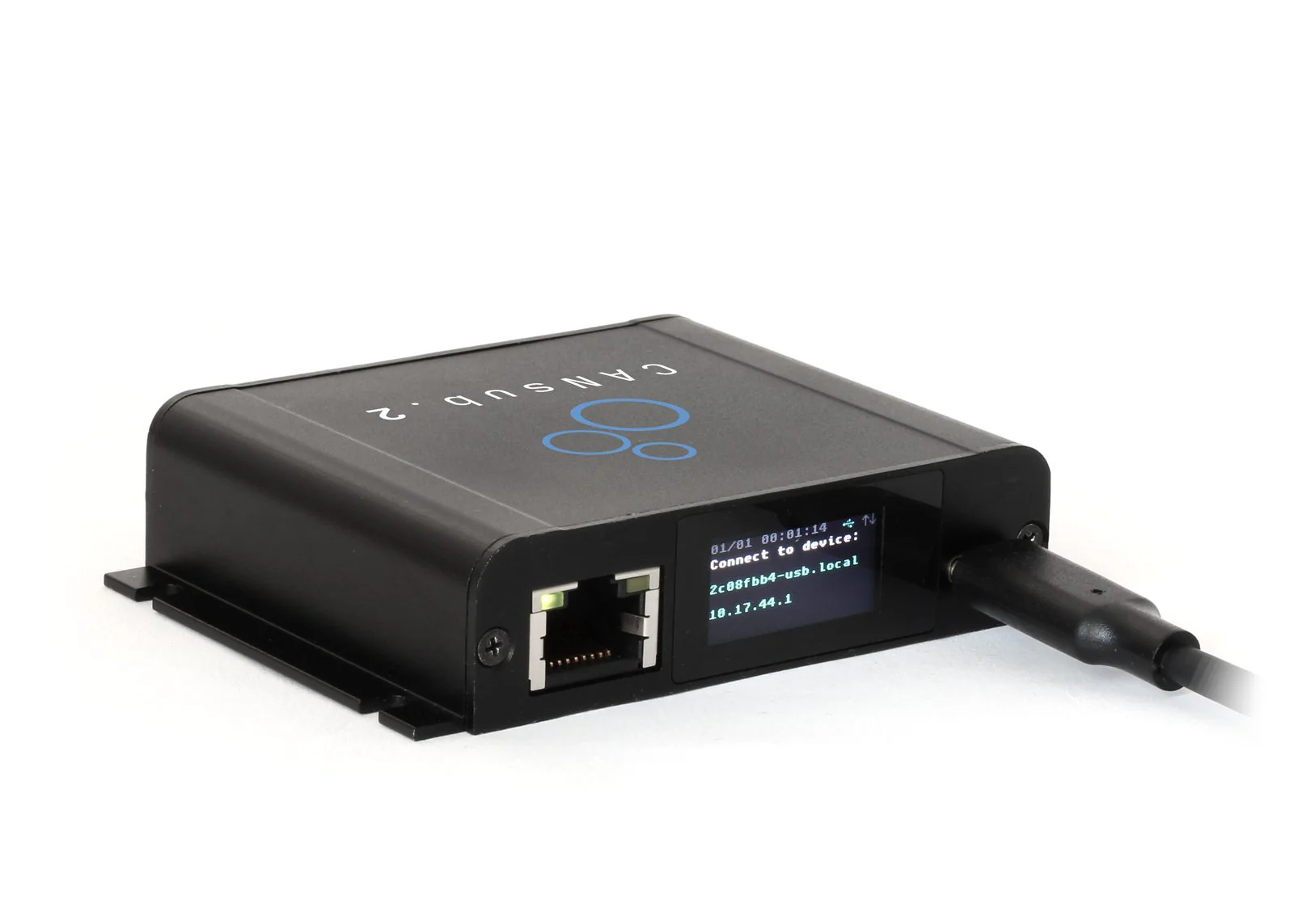

CANsub.2: Compact 2-channel CAN bus interface with galvanic isolation, webCAN, 1 μ s timestamp and >20,000 frames/s – ideal for testing and diagnostic purposes.
Volume discounts on request!
€350.00 Net
€416.50 incl. VAT
Shipping country
Customer Group
Währung
In Stock, Delivery time: 1-3 days
Model
.jpg)
.jpg)
.jpg)
.jpg)
.jpg)
.jpg)
Product configuration
Customize your product!
Click on a category below to view available options.


Description
Compact, professional CAN bus interface with two galvanically isolated CAN FD channels, USB-C, and Ethernet. Real-time streaming at over 20,000 frames/s and 1 µs timestamps, integrated webCAN web interface, and open REST/WebSocket APIs for easy integration into test environments and automation. Robust protection features and DBC decoding enable reliable diagnostics and development.
Features
- 2 x galvanically isolated CAN FD channels
- USB-C and RJ45 Ethernet interfaces
- Integrated webCAN browser interface (no driver required)
- Timestamp resolution of 1 μs
- More than 20,000 frames/second streaming throughput
- 160 × 80 px color TFT display for status and URL
- DB9 connectors for standard adapter cables
- Open REST and WebSocket APIs
- Transceiver protection: short circuit, bus fault, undervoltage
- Low power consumption, compact aluminum housing
The CANsub.2 is a compact, professional CAN bus interface with two galvanically isolated CAN FD channels and flexible USB-C and Ethernet interfaces. It streams CAN frames in real time at more than 20,000 frames/s and delivers microsecond-accurate timestamps (1 μs). This makes it ideal for raster loops, UDS/OBD testing, and real-time diagnostics.
The integrated webCAN interface runs directly on the device and enables browser-based monitoring, DBC decoding, signal plotting, and the execution of time-critical transmission tasks without additional software. Hardware ID filters, configurable silent modes, and transceiver protection mechanisms increase reliability in field operations. Typical applications include vehicle diagnostics, test benches in research and development, machine integration, and field service. For multiplex setups or the highest channel count, a four-channel model is available; adapter cables allow for easy integration into existing OBD2 or J1939 connectors. Openly documented APIs and Python/SavvyCAN support facilitate automation and integration into test or data acquisition processes. The lightweight and compact aluminum housing allows for easy mounting in test benches; the integrated color TFT display shows bus load, error rates, and the current bit rate. Galvanic isolation enables the safe parallel operation of multiple bus segments. Firmware updates are free and improve functionality throughout the product's lifespan.
The integrated webCAN interface runs directly on the device and enables browser-based monitoring, DBC decoding, signal plotting, and the execution of time-critical transmission tasks without additional software. Hardware ID filters, configurable silent modes, and transceiver protection mechanisms increase reliability in field operations. Typical applications include vehicle diagnostics, test benches in research and development, machine integration, and field service. For multiplex setups or the highest channel count, a four-channel model is available; adapter cables allow for easy integration into existing OBD2 or J1939 connectors. Openly documented APIs and Python/SavvyCAN support facilitate automation and integration into test or data acquisition processes. The lightweight and compact aluminum housing allows for easy mounting in test benches; the integrated color TFT display shows bus load, error rates, and the current bit rate. Galvanic isolation enables the safe parallel operation of multiple bus segments. Firmware updates are free and improve functionality throughout the product's lifespan.
Technical Data
| Device specification | CANsub.2 |
|---|---|
| Product number | CANsub.2 |
| Channels | 2 x CAN FD |
| Interfaces | USB-C, Ethernet (RJ45), 2 x DB9 |
| Timestamp | 1 μs resolution |
| Maximum throughput | More than 20,000 images/second |
| Advertisement | 160 × 80 px color TFT |
| Case & Dimensions | Aluminium, 75 × 67 × 20 mm |
| Weight | 90 g |
| power supply | +5V via USB-C (PoE optional) |
| Protection and insulation | Galvanic isolation, IP40 |
| Model comparison | CANsub.2 | .webp) CANsub.4 |
|---|---|---|
| Channels | 2 x CAN FD | 4 x CAN FD |
| Physical connection | 2 × DB9 | 1 × DB25 (optional DB25‑4xDB9) |
| Maximum throughput | More than 20,000 images/second | More than 20,000 images/second |
| Timestamp | 1 μ s | 1 μ s |
| Advertisement | 160 × 80 px TFT | 160 × 80 px TFT |
| Case / Weight | 75 × 67 × 20 mm / 90 g | 75 × 67 × 20 mm / 90 g |
Documentation
adapter

OBD2 to DB9 adapter cable
Product Nr.: CSS-39
The OBD2-DB9 adapter cable fits onto the connector near the steering wheel of your car.
€59.50*

OBD2/J1939-to-DB9/DB9-Adapterkabel
Product Nr.: CSS-157
The adapter cable fits onto the OBD2 connection near the steering wheel of a lorry.
€89.25*

J1939-to-DB9/DB9 adapter (F+G)
Product Nr.: CSS-159
This adapter cable fits the 9-pin J1939 connector used in most lorries, buses and tractors.
€89.25*

J1939-to-DB9/DB9 adapter (H+J)
Product Nr.: CSS-158
This adapter cable fits the 9-pin J1939 connector used in most lorries, buses and tractors.
€89.25*

J1939 to DB9 adapter cable
Product Nr.: CSS-40
The DB9-J1939 adapter cable is suitable for use in most heavy-duty vehicles.
€59.50*

M12 to DB9 5-pin adapter cable
Product Nr.: CSS-120
This 1.5 metre long DB9 to M12 adapter (5-pin) fits most marine vessels and CANopen devices.
€59.50*

CAT to DB9 adapter cable
Product Nr.: CSS-111
The CAT to DB9 German 9-pin adapter fits most Caterpillar heavy-duty vehicles.
€59.50*

DT06-to-DB9/DB9-Adapter
Product Nr.: CSS-207
This adapter cable fits the Volvo Penta DT06 Deutsch connector, which can be found in many marine engines.
€89.25*

Contactless CAN bus reader
Product Nr.: CSS-193
The contactless CAN reader analyses the raw CAN data via non-invasive electromagnetic fields.
€89.25*

Generic to DB9 adapter cable
Product Nr.: CSS-58
This cable serves as a starting point for customised cables for non-standard connections.
€59.50*
USB adapter
PoE Adapter
Mounting

CANedge mounting kit
Product Nr.: CSS-190
The CANedge mounting kit is a simple, flexible and compact solution for installing your CANedge CAN/LIN logger in the field.
€35.70*
Dual Lock Velcro straps for CANedge
Product Nr.: SW10948
With the 3M Dual Lock hook and loop tape, for example, you can quickly and easily attach your CANedge to any surface.
€11.90*