







€395.00 Net
€470.05 incl. VAT
In Stock, Delivery time: 1-3 days


Product configuration


Description
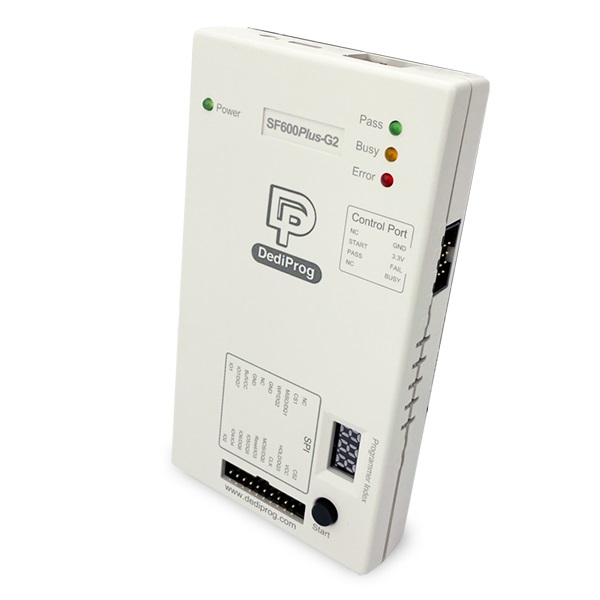
SF600Plus-G2 is a high-speed serial NOR/NAND flash programmer with in-circuit programming (updating the SPI flash soldered on the board) and standalone programming (updating the SPI flash in the socket adapter). With DediProg SF software and USB, it provides a user-friendly interface and powerful functions.
The newly developed SF600Plus-G2 is the improved version of SF600 and SF600Plus, which significantly increases the programming efficiency with the SOC architecture of FPGA. In addition to the original functions of the SF600/S600Plus, it can also support SPI NAND, which is convenient for the developer in programming.
Hardware Features
- High-speed USB and high SPI performance; the USB and standalone mode support any volume of SPI flash on the market.
- Supports 1.2V low voltage IC.
- Start button function: can batch when connected to the software.
- Protection against signal conflict.
- Multi-programmer capability via USB.
- Programmer index indicators on the programmer.
- Supports 2 CS pins.
- Stand-alone mode: support start button programming and control port to remove control programming.
- Supports WIN8 and above.
- Supports both 32bit and 64bit OS.
- Supports Single/Dual Multiple Dies.
- Supports Single/Dual/Quad/Octal. IO.
- Can be upgraded to SF600Plus-G2U.
Software Features
- PC based SF600-G2 programming software with different modes:
- Engineering Mode features advanced developer and repair functions
- Production mode for simultaneous control of multiple SF600-G2 programmers
- Command line for control of the SF600-G2 by user-defined software
- Supports Windows 2003 (32 bit and 64 bit) and higher
Applications
- Updating of the serial flash soldered to the board with or without power supply in standalone or PC GUI mode
- Prototype or low volume production, in-system or socket programming
- Control application, controller reset and MOSFET isolation status
- Update of internal flash (Ezport MCF5223, MCF5221, MCF5213) or external SPI flash (SBF interface MCF5445, MCF5227) of Freescale MCU
Hardware Details
SF600Plus-G2 is equipped with an ISP header. Through a corresponding connector, the user can connect the programmer and control the SPI signals, supply the memory and control the controller or application status. Please refer to Table 1 for the pinout of the SF600Plus-G2 2x10 header. DediProg also provides the SF600Plus-G2 2 piece ISP cable used to connect the programmer to the 2x10 and 2X6 (2.54mm) ISP header on the board, see Table 2: 2x10 and Table 3: 2x6 for the SF600Plus-G2 ISP cable pinout.
To get a clear understanding of the different ISP or backup boot methods and the different reference schemes, please download the application notes AN0103 and AN0106 under documentations.
| ISP Header Pin Out (2x10) | |||
|---|---|---|---|
| 1 | NC | CS2 | 2 |
| 3 | CS1 | VCC | 4 |
| 5 | MISO/DQ1 | HOLD/DQ3 | 6 |
| 7 | WP/DQ2 | CLK | 8 |
| 9 | GND | MOSI/DQ0 | 10 |
| 11 | NC | RESET/IO3 | 12 |
| 13 | GND | IO5/DQ5 | 14 |
| 15 | BufVCC | IO6/DQ6 | 16 |
| 17 | IO7/DQ7 | IO4/DQ4 | 18 |
| 19 | IO1 | IO2 | 20 |
| ISP Cable Connector Pin Out (2x10) | |||
|---|---|---|---|
| 1 | NC | CS2 | 2 |
| 3 | CS1 | VCC | 4 |
| 5 | MISO/DQ1 | HOLD/DQ3 | 6 |
| 7 | WP/DQ2 | CLK | 8 |
| 9 | GND | MOSI/DQ0 | 10 |
| 11 | NC | RESET/IO3 | 12 |
| 13 | GND | IO5/DQ5 | 14 |
| 15 | BufVCC | IO6/DQ6 | 16 |
| 17 | IO7/DQ7 | IO4/DQ4 | 18 |
| 19 | IO1 | IO2 | 20 |
| ISP Cable Connector Pin Out (2x6) | |||
|---|---|---|---|
| 1 | Vpp | CS2 | 2 |
| 3 | CS1 | Vcc | 4 |
| 5 | MISO/DQ1 | Hold/DQ3 | 6 |
| 7 | Wp/DQ2 | CLK | 8 |
| 9 | GND | MOSI/DQ0 | 10 |
| 11 | NC | Reset | 12 |
| Control Port | |
|---|---|
| NC | GND |
| Start | 3.3V |
| PASS | FAIL |
| NC | BUSY |
Performance
| Reference IC | Density | Program+Verify (25Mhz,Quad) |
|---|---|---|
| W25Q80JVSIQ | 8Mb | 6.3 |
| W25Q16VSIG | 16Mb | 12.5 |
| W25Q32VFIG | 32Mb | 18.7 |
| W25Q64FVBIG | 64Mb | 22.2 |
| MX25L12873FM2I | 128Mb | 41.9 |
| MX25L25645GMI | 256Mb | 46.6 |
| MX25L51245GMI | 512Mb | 96.8 |
| MX66L1G45JMI08 | 1Gb | 203.0 |
| Reference IC | Density | SF600/ SF600Plus | SF700 | SF600Plus-G2 |
|---|---|---|---|---|
| W25Q80JVSIQ | 8Mb | 2.5 | 2.4 | 1.5 |
| W25Q16VSIG | 16Mb | 2.4 | 2.3 | 1.4 |
| W25Q32VFIG | 32Mb | 3.3 | 3.0 | 1.8 |
| W25Q64FVBIG | 64Mb | 4.9 | 4.5 | 2.5 |
| MX25L12873FM2I | 128Mb | 8.2 | 7.3 | 4.1 |
| MX25L25645GMI | 256Mb | 15.8 | 14.0 | 7.5 |
| MX25L51245GMI | 512Mb | 29.6 | 26.1 | 13.8 |
| MX66L1G45JMI08 | 1Gb | 57.2 | 50.3 | 26.2 |
Softwaremodes

Expertmode
Allows access to advanced features such as defining custom commands for development or repair.

Production mode
Production mode allows silmultaneous control of up to 8 SF Series programmers to increase throughput.

Command line mode
Allows control of one or more SF Series programmers via a user-defined program.
Supported ICs
F.A.Q.
Yes. "SF600-G2" is a common shorthand. Dediprog's official model name is SF600Plus-G2. It succeeds the SF600 and SF600Plus, and it also replaced the discontinued SF700. Don't confuse it with the SF600Plus-G2U, a newer variant that adds EEPROM programming. An SF600Plus-G2 can be upgraded to the G2U later, so you don't need to decide now.
Yes. The SF600Plus-G2 supports low-voltage devices down to 1.2V, so 1.8V SPI flash is programmed directly. No external level shifter is needed. Select the exact part number in the SF software and the programmer sets the supply and I/O voltage to match. This matters on 1.8V platforms, because driving 3.3V signals into the board can damage the flash or the main processor.
No. The box includes ISP cables (2x10 and 2x4), the SF600 universal adapter and a socket bottom board, but no test clip. If the board has no ISP header and you want to clip directly onto a soldered SOIC8 flash, add the EM-TC-8 SO8 test clip with 2x10 connector. It plugs straight into the SF600Plus-G2.
Connect the SF600Plus-G2 to the board's SPI flash, either through an ISP header or an SO8 test clip, and use In-Circuit Programming mode. The usual problem with in-circuit flashing is that the chipset or MCU shares the SPI bus and interferes. The SF600Plus-G2 header has a reset line to hold the controller in reset while you program. Dediprog's application notes AN0103 and AN0106 (in the Documentation tab) explain the isolation options. For Intel boards with a dedicated SPI header, the Intel ISP Adapter-B gives a direct connection.
Yes. This is the main difference from the SF100 and the older SF600Plus, which support SPI NOR only. The SF600Plus-G2 supports SPI NOR, SPI NAND and Octal SPI NOR, in Single, Dual, Quad and Octal I/O modes. Check your exact part number in the supported chips list before ordering.
Yes, through the command line. Dediprog's graphical SF software runs on Windows. For Linux, Dediprog publishes an open-source command-line tool on GitHub (DediProgSW/SF100Linux). It supports the SF100, SF600, SF600Plus, SF600Plus-G2 and SF700. It suits scripted and CI-based flashing. For the full GUI with engineering and production modes, use a Windows PC.
Per Dediprog's reference measurements, quad read is roughly twice as fast. A 128Mb flash (MX25L12873F) reads in 4.1 s, compared with 8.2 s on the SF600/SF600Plus and 7.3 s on the SF700. A 1Gb device reads in 26.2 s, compared with 57.2 s on the SF600Plus. A full program and verify of a 1Gb flash at 25 MHz quad takes about 203 s.
Yes. Load the project from the SF software once, then run the programmer in standalone mode using the start button. The control port provides START, PASS, FAIL and BUSY signals, so you can integrate it into a test fixture or ATE. When connected to a PC, production mode drives up to 8 SF programmers at once, and the command line lets your own software control them. The SF100 has no standalone mode.
The SF600Plus-G2 supports both families for offline (socket) programming, but through different bottom boards. Since 1 June 2026, the standard package includes the NuProgPlus Socket Bottom Board (SF600PG2-ISP-board-NPP) instead of the ProgMaster board. The two boards use different sockets and are not interchangeable. If your lab already uses ProgMaster socket adapters, order the SF600PG2-ISP-board-PM separately.
Technical Data
| Model Comparison |  SF100 |  SF600 Plus |  SF600-G2 |  NuProg-E2 |
|---|---|---|---|---|
| Supported IC Types | SPI NOR Flash | SPI Flash NOR | SPI NOR & SPI NAND and SPI Octal NOR | UFS (Up to180 MB/s) eMMC (Up to 100 MB/s) |
| In System Programming | ✓ | ✓ | ✓ | X |
| Socket Programming | ✓ With Bottom Board (Option) | ✓ One Programming Site | ✓ One Programming Site | ✓ One Programming Site |
| Standalone | X | ✓ | ✓ | X |
| Software | SF Software | SF Software | SF Software | Dediware |
| 3rd Party Integration | CLI | CLI | ATE Port, CLI | X |
Documentation
Accessories


Freehand connection kits

Produkt abgekündigt

Produkt abgekündigt
eVision Praxis