







€899.00 Net
€1,069.81 incl. VAT
Delivery time 1 to 3 days
.jpg)
.jpg)
.jpg)
.jpg)
.jpg)
.jpg)
- 3-year warranty
- 2.5% advance payment discount
- If you use the payment method in advance by bank transfer, 2.5% of the purchase amount will be automatically deducted at the checkout.
Product configuration


Description
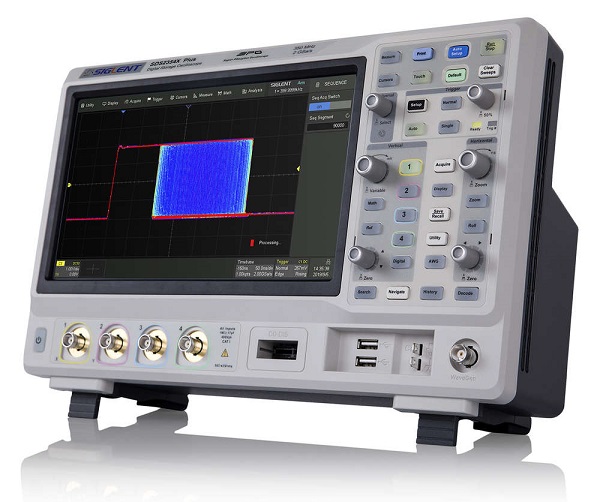
The Siglent SDS2102X Plus oscilloscope impresses with its powerful hardware and a wide range of features. This model offers a bandwidth of 100 MHz, as well as 4 analog and 16 digital channels with mixed-signal analysis capability. The SDS2102X has a maximum sampling rate of 2 GSa/s and a maximum recording length of 200 Mpts/channel.
Features
- Available bandwidths: 350 MHz, 200 MHz and 100 MHz
- Real-time sampling rate of up to 2 GSa/s. An upgrade option for 500 MHz bandwidth is available for 350 MHz models.
- SPO technology
- Signal acquisition rates up to 120,000 wfm/s (normal mode) and 500,000 wfm/s (sequence mode)
- Supports intensity gradation and color temperature display modes with 256 levels
- Recording length up to 200 Mpts/channel, a total of 400 Mpts for all 4 channels
- Digital trigger system
- Intelligent triggering: Edge, Slope, Pulse, Window, Runt, Interval, Failure, Pattern, and Video (HDTV supported). The trigger zone simplifies advanced triggering.
- Serial bus triggering and decoder, supports the protocols I2C, SPI, UART, CAN, LIN (standard) and CANFD, FlexRay, I2S and MIL-STD-1553B (optional)
- Low background noise with voltage scales from 0.5 mV/div to 10 V/div
- The 10-bit mode offers higher resolution and lower noise.
- Segmented acquisition mode (sequence mode) in which the maximum data record length is divided into multiple segments (up to 90,000) according to the trigger conditions defined by the user, with a very short dead time between the segments for the acquisition of the qualifying event.
- Progressive waveform recording function (progress) for up to 90,000 triggered waveforms (frames)
- Automatic measurement function for more than 50 parameters, supports statistics with histogram and trend.
- Two mathematical traces support 2 Mpts FFT, +, -, x, ÷, d / dt, ∫dt, √, average, ERES and formula editor
- Numerous data processing and analysis functions such as search, navigation, mask testing, Bode plot, performance analysis (optional) and counters
- 16 digital channels (optional)
- Built-in 50 MHz waveform generator (optional)
- Large 10.1-inch TFT-LCD display with a resolution of 1024 × 600; the capacitive touchscreen supports multi-touch gestures.
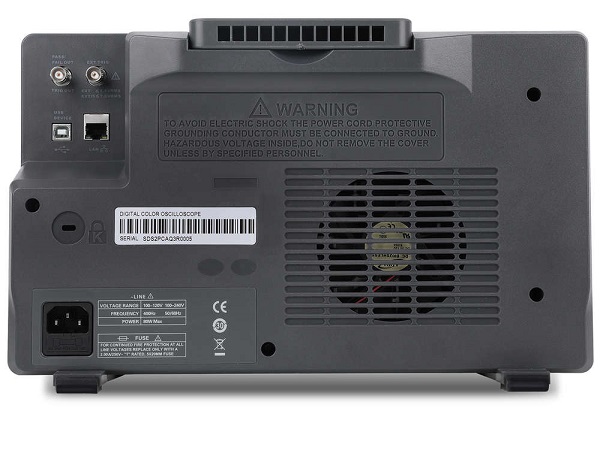
- Multiple interfaces: USB host, USB device (USBTMC), LAN (VXI-11 / Telnet / Socket), Pass / Fail, Trigger Out
- The integrated web server supports remote control via the LAN port using a web browser. It also supports SCPI remote control commands.


Hardware details
The SDS2000X Plus series utilizes SIGLENT's SPO technology with a maximum waveform acquisition rate of up to 120,000 wfm/s (normal mode, up to 500,000 wfm/s in sequence mode), a 256-step intensity gradation display function, and a color temperature display mode. It also employs an innovative, high-sensitivity, low-jitter digital trigger system. This trigger system supports multiple powerful trigger modes, including serial bus triggering. History recording, sequence acquisition, search, and navigation functions enable the capture, storage, and analysis of advanced signal recordings. An impressive array of measurement and mathematical functions, options for a 50 MHz waveform generator, serial decoding, mask testing, Bode plotting, and power analysis are also features of the SDS2000X Plus.
The numerous operating options, such as the input of multi-touch gestures via the large 10.1 inch display, remote control via the web or the ability to navigate with keyboard and mouse, greatly increase the user-friendliness and work efficiency of models in the SDS2000X Plus series.
Product Highlights

50 MHz waveform generator
The built-in waveform generator can output waveforms with a frequency of up to 50 MHz and an amplitude of ±3 V. Six basic waveforms are supported, along with several types of predefined waveforms and user-defined arbitrary waveforms.

History mode
The history function records up to 90,000 triggered waveforms (frames). This happens continuously in the background, allowing the history waveforms to be replayed at any time to find and analyze past events. Serial decoding, zoom, and cursor measurements can be used.

Recording length of up to 200 Mpts/ch
Using a hardware-based zoom technique and a recording length of up to 200 Mpts, users can select a slower time base without affecting the sampling rate, and then quickly zoom in to focus on the area of interest.

Search and navigate
The SDS2000X Plus oscilloscope can locate events within a recording and history based on user-defined trigger conditions. Navigate through the events flagged by the search, replay history frames, or continuously shift the delay position in long recordings (useful in zoomed view).

Up to 120,000 wfm/s signal update rate
With a signal update rate of up to 120,000 wfm/s, the oscilloscope can easily capture low-probability events. In sequence mode, the signal acquisition rate can reach 500,000 wfm/s.

Sequence mode
The segmented memory collection stores the waveform in multiple memory segments (up to 90,000), and each segment stores a triggered waveform along with the dead-time information. The interval between segments can be as small as 2 µs. All segments can be played back at any frame rate using the history function.

Bode Plot
The SDS2000X Plus can control the built-in waveform generator or any standalone SIGLENT SDG device to scan the amplitude and phase response versus frequency of passive or active circuits. The data is displayed as a Bode plot. This allows expensive network analyzers to be replaced in less demanding applications.

Hardware-based high-speed mask testing function
The SDS2000X Plus uses a hardware-based mask testing function that performs up to 80,000 pass/fail decisions per second. It is easy to create custom test templates that allow for continuous comparison of the signal history. Failed frames can be automatically saved as history frames or screenshots.

Front-end performance
500 MHz bandwidth (at 2 GSa/s sampling rate with 500 MHz bandwidth option).

Digital Channels / MSO
Four analog channels plus 16 digital channels enable the capture and triggering of mixed waveforms with one instrument.

Serial bus decoding
In addition to the decoder tracks assigned to the waveform, bus protocol information can be displayed in tabular form. I2C, SPI, UART, CAN, LIN, CAN FD, FlexRay, I2S and MIL-STD-1553B are supported.

Performance analysis
The Power Analysis option offers a full range of power measurements and analyses, thus improving the efficiency of measurement in switched-mode power supplies and power device designs.

Trigger area
The trigger zone is available for extended triggering.

High connectivity
2 x USB host, 1 x USB device (USBTMC)
1 x LAN (VXI-11/Telnet/Socket)
1 x Auxiliary output (Pass/Fail and Trigger Out)

Trigger functions
Edge, Slope, Pulse, Video, Windows, Runt, Interval, Dropout, Pattern and Serial Trigger.

10-bit mode
The 10-bit mode, in combination with zoom, shows you more detail and less noise in the waveform.

Measurements for all relevant parameters and parameter statistics
Parameter measurements comprise four categories: horizontal, vertical, other, and channel delay, offering over 50 different measurement types. Measurements can be performed within a specific gate period. Measurements in mathematical, reference, and trend frames are supported. Statistics display the current value, maximum value, minimum value, standard deviation, and mean of up to 12 parameters simultaneously. A histogram is available to display the probability distribution of a parameter. Furthermore, horizontal measurements can process up to 1000 signal edges within a single frame.

Extended mathematical function
Two mathematical traces, support for FFT, +, -, x, ÷, d/dt, ∫dt, √, average, ERES, and a formula editor. Hardware-accelerated FFT up to 2 Mpts provides high frequency resolution with a fast refresh rate. The FFT function also supports a variety of window functions, allowing it to adapt to different spectrum measurement requirements. Three modes (Normal, Average, and Max Hold) can meet different power spectrum observation needs. Automatic peak detection and markers are supported.
Technical Data
| Device specification |  SDS2102X Plus | SDS2104X Plus | SDS2204X Plus | SDS2354X Plus |
|---|---|---|---|---|
| bandwidth | 100 MHz | 100 MHz | 200 MHz | 350 MHz |
| Channels | 2+ EXT | 4+ EXT | 4+ EXT | 4+ EXT |
| Sampling rate (real-time) | 2 GSa / s | 2 GSa / s | 2 GSa / s | 2 GSa / s |
| Detection rate | 120,000 Wfm/s | 120,000 Wfm/s | 120,000 Wfm/s | 120,000 Wfm/s |
| Storage depth | 200 Mpts / ch | 200 Mpts / ch | 200 Mpts / ch | 200 Mpts / ch |
Documentation
software
Accesories
Freehand probes